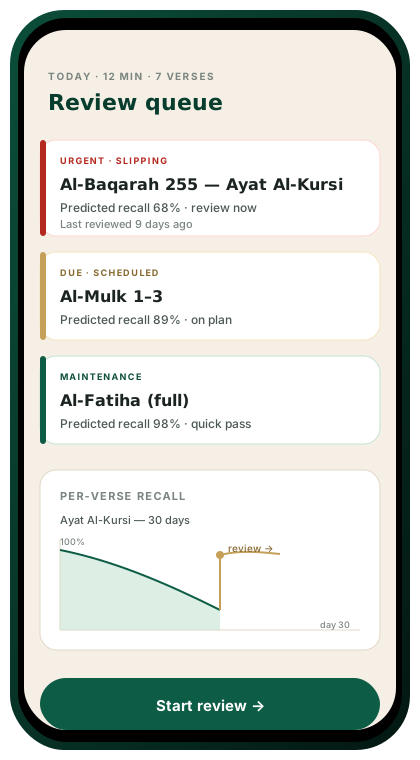
Why ordinary hifz routines fail
Hermann Ebbinghaus’s 1885 research (replicated and refined ever since) shows that after memorizing something, up to ~70% can be forgotten within 24 hours without review. Traditional hifz combats this with muraja’a — daily, weekly, and monthly revision cycles. Those cycles work — when the memorizer’s life allows them. Most lives don’t.
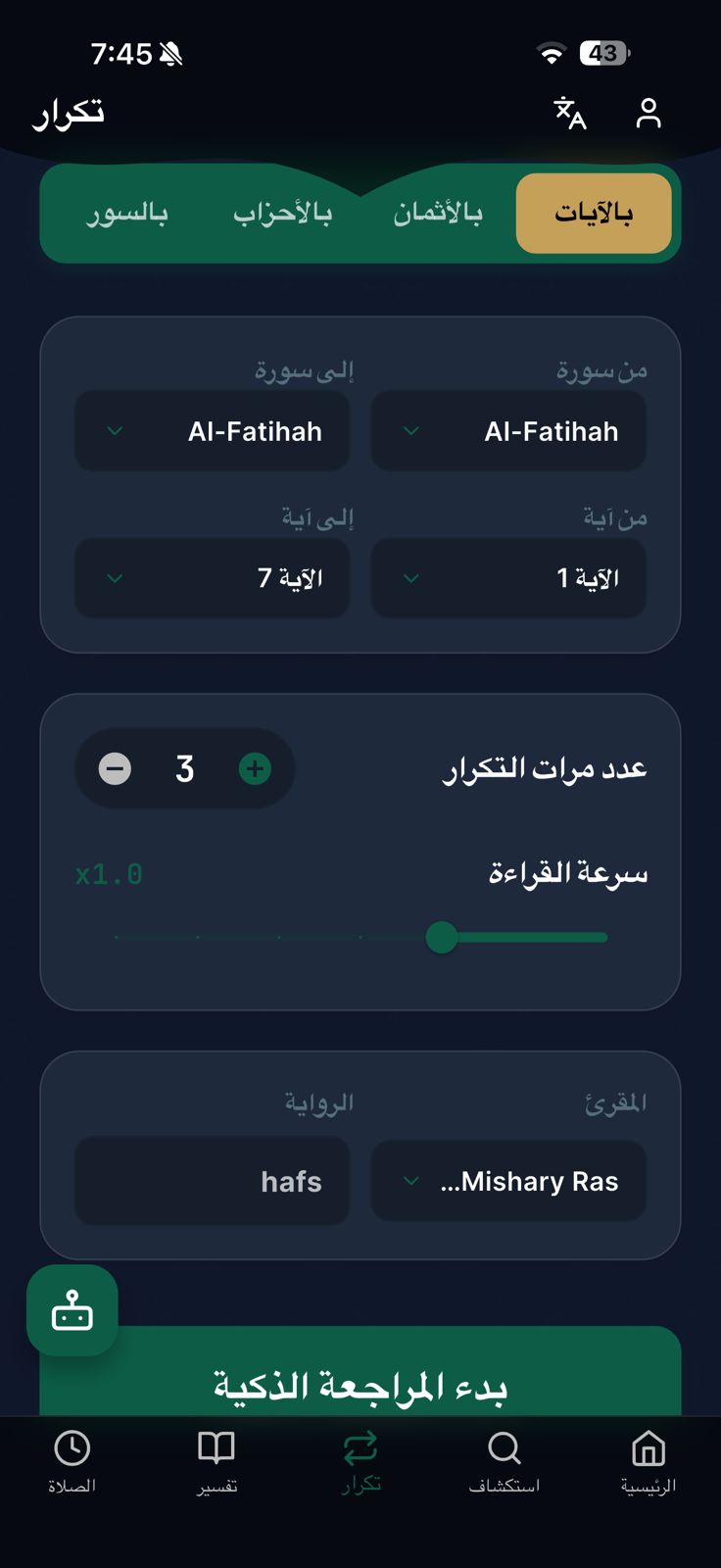
HafizPrime automates the science of when to revise, so discipline can focus on actually showing up.
How our retention engine works
Each verse you memorize carries its own forgetting curve, shaped by four inputs:
- Recency — how long since you last recited it without error.
- Accuracy — how precisely you matched, word by word, on the last attempt.
- Frequency — how many successful recitations in the last 30 days.
- Difficulty — how often this verse (or its mutashabihat peers) slipped in the past.
The model predicts the moment your estimated recall probability dips toward ~85%. That’s when the verse is scheduled for review — before you’d notice it slipping.
Compared to static SRS
Classic spaced-repetition systems (Leitner boxes, SuperMemo SM-2, Anki’s default algorithm) use fixed intervals: 1 day, 3 days, 7 days, 14 days, etc. They ignore:
- Your individual forgetting rate (which varies per person and per verse).
- Mutashabihat confusion (similar verses compete).
- Recent life context (a skipped week needs catch-up, not linear scheduling).
HafizPrime’s model adjusts these in real time.
Daily review flow
Every morning, the app computes “today’s review queue”:
- Urgent — verses about to slip (red ring).
- Due — scheduled reviews (amber ring).
- Maintenance — verses you’ve mastered (green ring, less frequent).
Work through it. Skip what you can’t do today. The schedule adapts.
The retention score
A single 0–100 number reflecting the health of your current memorization. Live, per-verse weighted. Tap it to see the heat map across all 114 surahs.
Learn about the Retention Score →
What the research says
- Ebbinghaus, H. (1885). Memory: A Contribution to Experimental Psychology.
- Wozniak, P. A., & Gorzelanczyk, E. J. (1994). Optimization of repetition spacing in the practice of learning.
- Karpicke, J. D., & Roediger, H. L. (2008). The Critical Importance of Retrieval for Learning.
- Modern NLP-backed spaced-repetition work at Duolingo and Anki, informing the “half-life regression” family of models.
We don’t claim to have invented spaced repetition. We’ve tuned it for the specific shape of Quranic Arabic, mutashabihat, and tajweed — and wired it to a recitation verifier.
FAQ
How fast does the schedule adapt?
Within one session. Miss a verse today; you’ll see it tomorrow — not in a week.
Can I override the schedule?
Yes. You can pin any verse to “review now,” freeze a section while traveling, or reset a surah’s schedule if you’ve started over.
Does it work for someone who finished the Quran years ago?
Especially well. Returning hafiz often use HafizPrime just for revision. The model treats “already memorized” as a strong prior and focuses on maintenance.

